
Breaking the Sound Barrier: The Physics Behind Felix Baumgartner's Free Fall
A journey to the stratosphere to unveil the secrets of gravity, air resistance, and the human courage that pushed the boundaries of modern physics.
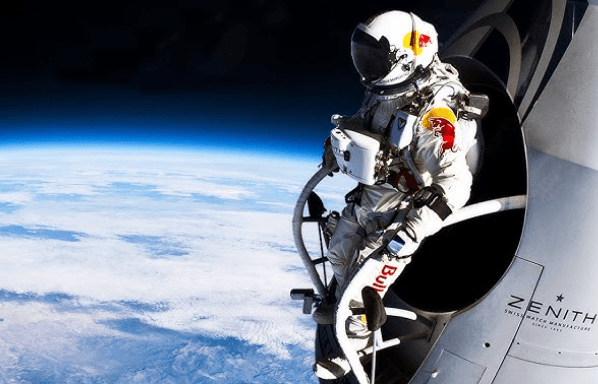
October 14, 2012. The world held its breath. Millions of eyes were fixed on a flickering live feed coming from the edge of space. Nearly 24 miles above the New Mexico desert, one man leaned into a silent abyss. Below, our blue planet floated in a black vastness. No wind, no noise—only the sound of his own breathing inside the helmet.
"Sometimes you have to go up really high to understand how small you are."
With one final sentence for the history books—"I'm going home now"—Felix Baumgartner stepped forward and surrendered to the void. That day, he didn't just break records; he gave us a live, global-scale masterclass in physics. But what science was truly hidden behind that 4-minute and 19-second free fall? Join us on this journey as we unravel it.
The Calm Before the Storm: Ascent and Vertical Motion
Before you can fall, you first have to rise. Felix's journey didn't begin with his jump, but with an agonizingly slow ascent lasting over two hours. Inside his capsule, lifted by a massive helium balloon, he faced the first law of physics: gravity.
Diary from the Edge of Space
Picture the scene: you are alone, ascending through increasingly thin layers of the atmosphere. The outside temperature plummets to -94°F (-70°C). Your life depends on a complex pressurized suit, a marvel of engineering that protects you from pressure so low that, without it, your blood would literally boil. This ascent is a perfect example of vertical motion: a constant struggle against the gravitational force pulling you down.
In physics, we call this vertical kinematics. It's the one-dimensional motion of an object moving vertically, losing velocity as it rises or gaining it as it falls, always under the influence of gravitational acceleration (g ≈ 9.8 m/s²). The equations governing this are the foundation of kinematics:
Vertical Motion Formulas
- Final Velocity ($v_f$): $v_f = v_0 - g \cdot t$
- Position ($y$): $y = y_0 + v_0 \cdot t - \frac{1}{2} g \cdot t^2$
Where $v_0$ is initial velocity, $g$ is the acceleration due to gravity, and $t$ is time.
Experiment with Gravity
Want to intuitively understand how initial velocity affects height? Don't just stick to the formulas.
The Leap into the Void: The Physics of Free Fall
When Felix jumped, he entered an environment few humans have ever experienced. At that altitude, the atmosphere is so thin that air resistance is almost zero. During the first few seconds, he lived the purest definition of free fall: a body moving solely under the influence of gravity.
Free Fall Formulas
For a dropped object (zero initial velocity), the equations simplify:
- Velocity ($v$): $v = g \cdot t$
- Distance Fallen ($d$): $d = \frac{1}{2} g \cdot t^2$
Without the braking force of the air, his body accelerated brutally. Gravity was "gifting" him 9.8 m/s of velocity every second. In less than a minute, he reached a top speed of 843.6 mph (Mach 1.25). But this milestone came with a deadly danger: an uncontrolled flat spin that threatened to make him lose consciousness.
Felix's Journey: A Fall Through Physics
The Leap into the Void 👨🚀
Air density ($\rho$) is near zero. The only significant force is gravity, causing pure acceleration.
Supersonic Breakthrough 💨
Peak velocity: 843.6 mph (Mach 1.25). Air resistance ($F_d$) begins to be noticeable.
Atmospheric Braking 🌪️
Air density increases. Drag grows exponentially, slowing down the acceleration.
Terminal Velocity ⚖️
Air resistance equals gravity ($F_d = F_g$). Acceleration is zero and velocity stabilizes.
Deployment & Landing 🪂
The parachute increases the surface area ($A$), multiplying the drag for a safe landing.
Battling the Air: Terminal Velocity
As he descended, the air grew denser. Air molecules became an invisible "wall". This drag force grew with his speed, pushing back against gravity.
Here is where the key concept appears: terminal velocity. It's the point where the downward force of gravity equals the upward force of air resistance. At that moment, the net force is zero, acceleration stops, and the object falls at a constant speed.
The Physics Behind Terminal Velocity
The drag force ($F_d$) is not constant; it depends on several variables:
- Drag Equation: $F_d = \frac{1}{2} \rho v^2 C_d A$
Where $\rho$ is air density, $v$ is velocity, $C_d$ is the drag coefficient (dependent on the object's shape), and $A$ is the cross-sectional area. When the force of gravity ($F_g = mg$) equals air resistance ($F_d$), we reach terminal velocity ($v_t$):
- Terminal Velocity Equation: $v_t = \sqrt{\frac{2mg}{\rho C_d A}}$
This state isn't reached instantly. Velocity approaches this value asymptotically: acceleration decreases as velocity increases, getting closer and closer to terminal velocity over time, but theoretically never reaching it in finite time. That's why Felix had a very high terminal velocity in the stratosphere (where air density $\rho$ is very low) and a much lower one when reaching the dense lower atmosphere.
Stratospheric Jump Velocity
Animated visualization of Felix Baumgartner's velocity profile during his historic free fall.
Relive the Historic Moment
Experience the Physics Yourself
Observe how air resistance affects speed and discover the terminal velocity from different altitudes.
Conclusion: One Hero, One Planet, and the Laws of the Universe
Felix Baumgartner's leap was a feat of engineering, courage, and human endurance. But above all, it was a humbling demonstration of the immutable laws that govern our universe. He showed us that to push our boundaries, we must first deeply understand the rules of the game. From Newton's apple to a man falling from space, gravity and physics connect us all.
And now, thanks to modern web technology, you can experiment with these rules too. We invite you to explore our virtual labs and feel, for a moment, like a pioneer defying gravity to better understand the world around you.
